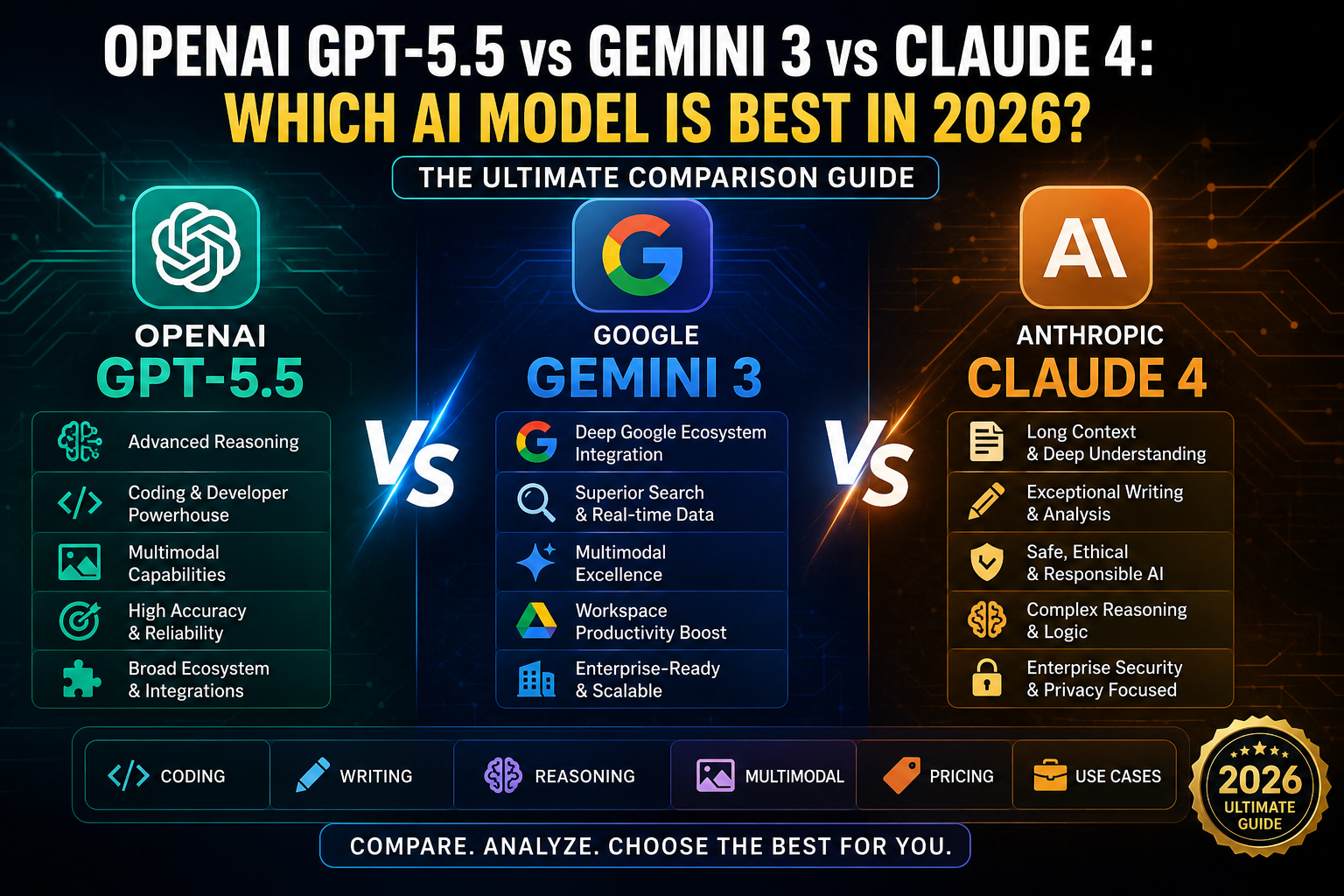
OpenAI GPT-5.5 vs Gemini 3 vs Claude 4: Which AI Model Is Best in 2026? The Ultimate Comparison Guide
Compare OpenAI GPT-5.5, Google Gemini 3, and Anthropic Claude 4 in this comprehensive 2026 guide. Explore coding, reasoning, writing, multimodal capabilities, pricing, business use cases, and discover which AI model is best for developers, creators, enterprises, and students.
Meta Title: GPT-5.5 vs Gemini 3 vs Claude 4: Best AI Model 2026? | Ultimate Comparison
Meta Description: GPT-5.5 vs Gemini 3 vs Claude 4 — ultimate 2026 AI comparison. Benchmarks, pricing, coding, agents & real-world use cases. Find your perfect AI model.
Focus Keywords: GPT-5.5 vs Claude 4, best AI model 2026, AI model comparison 2026, Gemini 3 vs Claude 4, GPT-5.5 review, LLM comparison 2026
Quick Answer — 30 Second Summary
There is no single best AI model in 2026. The right choice depends entirely on your task. Here is the verdict at a glance:
- GPT-5.5 — Best for autonomous agents, agentic workflows, multi-step tool execution, and computer use automation.
- Claude Opus 4.8 — Best for coding accuracy, long-form writing, research summaries, and tasks where hallucination risk is unacceptable.
- Gemini 3.1 Pro — Best for value, cost-efficiency, 1M token context tasks, whole-codebase analysis, and Google Workspace users.
Table of Contents
- 2026 AI Landscape — What Has Changed
- Model-by-Model Deep Dive
- Full Benchmark Comparison Table
- Pricing Breakdown
- Performance by Use Case
- Context Window Comparison
- Developer and Builder Perspective
- Which Model Is Best for SEO and GEO Content?
- Enterprise and Team Considerations
- The Multi-Model Strategy
- Frequently Asked Questions
- Final Verdict and Recommendations
- Hashtags and Keywords
- About the Author
1. 2026 AI Landscape — What Has Changed
The AI arms race entered a genuinely new phase in 2026. For the first time since ChatGPT launched, the debate is no longer about which model is smarter. The debate is about which model is better for your specific job. That is a fundamental shift and it changes how you should approach model selection entirely.
OpenAI, Anthropic, and Google all shipped major flagship updates within weeks of each other in mid-2026:
- OpenAI GPT-5.5 — Released April 23–24, 2026. Became the default ChatGPT model on May 5, 2026.
- Claude Opus 4.7 — Released April 2026. Succeeded almost immediately by Claude Opus 4.8 on May 28, 2026.
- Gemini 3.1 Pro — Google flagship mid-2026 model. Gemini 3.5 Flash also went live in May 2026 for speed-sensitive use cases.
What makes this round uniquely fascinating is the convergence at the top. On the LMArena leaderboard — which aggregates over 6.8 million blind human preference votes across 360+ models — the top three accessible models are separated by fewer than 55 Elo points. One year ago, that spread between first and fifth place was several times wider.
Key Insight for 2026: Choosing an AI model is no longer about finding the smartest one. It is about matching a model strength profile to your actual workload. The quality gap at the frontier is the smallest it has ever been — but the capability profiles are more differentiated than ever.
This convergence is real and measurable. On GPQA Diamond — a set of PhD-level science questions — GPT-5.5 scores 94.0%, Gemini 3.1 Pro scores 94.1%, and Claude Opus 4.8 scores 93.6%. That is a three-way photo finish. Traditional benchmarks are losing discriminating power at the top. The meaningful differences now live in agentic execution, cost, context window, and domain-specific tasks.
This guide breaks all of that down with real benchmark numbers, real pricing, and honest assessments of where each model wins and loses. No fluff, no brand loyalty. Just the data you need to make the right call.
2. Model-by-Model Deep Dive
OpenAI GPT-5.5
Released: April 23, 2026 | Best for: Autonomous Agents
GPT-5.5 is OpenAI clearest departure from the best chatbot paradigm. This model was engineered from the ground up for autonomous, multi-step execution — calling external tools, maintaining state across long tasks, recovering from errors without human intervention, and operating natively across text, image, audio, and video.
If you evaluate GPT-5.5 as a general-purpose assistant, you may feel underwhelmed. If you are building agentic workflows or running complex automation pipelines, you might be looking at your new primary model. The context window stays at 256K tokens — unchanged from GPT-5.4 — but the improvements in instruction persistence and tool orchestration are significant.
Architecture: GPT-5.5 is natively omnimodal — text, image, audio, and video flow through a single unified architecture rather than a stack of bolt-on modules. This makes it more coherent for multimodal tasks than previous generations. It is also the default model in OpenAI Codex environment, which is where most developers encounter it first.
Agentic Performance: This is GPT-5.5 clearest competitive strength in 2026. Its Terminal-Bench score of 82.7% vs Claude Opus 4.7 at 69.4% represents the first time OpenAI has led Anthropic on agentic execution benchmarks since GPT-4. Its OSWorld score of 78.7% further establishes it as the leader in computer use scenarios.
The Hallucination Problem: GPT-5.5 most significant weakness is factual accuracy on long-form tasks. In independent testing, it hallucinates at roughly 86% on long-form factuality tests compared to Claude Opus 4.7 at 36%. That gap matters most for client-facing writing, research summaries, and any professional deliverable where accuracy is the product.
Strengths:
- Best-in-class agentic execution — Terminal-Bench 82.7%
- Top computer use performance — OSWorld 78.7%
- Natively omnimodal architecture
- Fewer tool calls needed per task
- Default Codex model for developers
- Good for tone-sensitive copywriting
Weaknesses:
- High hallucination rate on long-form tasks — approximately 86%
- Most expensive at scale — $35 per million tokens
- 256K context window — lowest of the three
- Underwhelming for simple chat use cases
- Benchmark improvements over GPT-5.4 are incremental
Claude Opus 4.8 (Anthropic)
Released: May 28, 2026 | Best for: Accuracy and Coding
Claude Opus 4.8 is Anthropic most capable publicly available model and the current holder of the top spot on the LMArena human-preference leaderboard — approximately 1,510 Elo points, with GPT-5.5 Pro and Gemini 3.1 Pro Preview close behind. It succeeds Claude Opus 4.7 (April 2026) with stronger agentic capabilities and improved honesty in code review.
The core Anthropic design philosophy — prioritizing safety, accuracy, and extended reasoning depth — is visible in every benchmark. Claude Opus 4.8 does not try to be the fastest or the cheapest. It tries to be the most reliable, and by most measures it succeeds.
Coding Excellence: Claude Opus 4.8 holds an 88.6% score on SWE-bench Verified — the highest publicly available score for real-world GitHub issue resolution as of mid-2026. This means it can successfully resolve nearly 9 out of 10 real software engineering tasks. For teams where code correctness and reviewability matter more than raw execution speed, Claude Code is the clearest choice.
Factual Accuracy: Claude long-form factual accuracy is the best among frontier models. With a hallucination rate of approximately 36% on long-form factuality tests — compared to GPT-5.5 at 86% — Claude is the model you reach for when the output is going to a client, a publication, or a professional context where errors carry real consequences.
Extended Thinking: Claude Opus 4.8 supports extended thinking mode for complex step-by-step reasoning tasks. It can also run hundreds of parallel subagents for large-scale autonomous tasks via Claude Code — a capability that makes it competitive with GPT-5.5 on certain agentic workloads despite lower single-agent benchmark scores.
Strengths:
- Best real-world coding — SWE-bench 88.6%
- Lowest hallucination rate — approximately 36%
- Number 1 on human preference leaderboard
- Extended thinking for complex reasoning
- Best for client-facing writing and research
- Parallel subagents via Claude Code
Weaknesses:
- Slower on pure agentic speed benchmarks
- 200K context window — mid-tier
- Can be verbose on edge cases
- Service reliability issues — 3 outages reported in March 2026
- $30 per million tokens — mid-range pricing
Gemini 3.1 Pro (Google)
Released: Mid-2026 | Best for: Value and Scale
Gemini 3.1 Pro is Google value champion — and in 2026, value champion does not mean consolation prize. It delivers near-frontier performance at roughly half the price of its competitors, with the largest context window in the industry and native integration into Google entire productivity suite.
Google strategy is clear: lead on cost, scale, and ecosystem. Gemini 3.1 Pro is priced to win high-volume API workloads, whole-codebase analysis, and organizations already running on Google Workspace. It actually edges out both competitors on GPQA Diamond at 94.1% vs GPT-5.5 at 94.0% and Claude at 93.6%, proving it is no slouch on pure reasoning.
The 1M Token Context Window: This is Gemini most distinctive and currently unmatched capability. When your workload requires loading an entire codebase, a year worth of meeting transcripts, or a massive research document collection into a single context, Gemini 3.1 Pro is the only frontier model that can do it. GPT-5.5 sits at 256K and Claude at 200K — both fall significantly short.
Cost Efficiency: At approximately $2 input and $12 output per million tokens, Gemini 3.1 Pro costs roughly 2.5 times less than Claude Opus 4.8 and GPT-5.5. For teams processing millions of tokens in classification, summarization, or automated pipeline tasks, this pricing difference is enormous.
Google Workspace Integration: Gemini deepest advantage for enterprise teams is native integration with Google Meet, Drive, Docs, Gmail, and Sheets. If your organization runs on Google Workspace, Gemini offers the smoothest end-to-end workflow.
Strengths:
- 1 million token context window — unmatched
- Cheapest flagship — approximately $14 per million tokens
- Highest GPQA Diamond score — 94.1%
- Native Google Workspace integration
- Best for high-volume batch processing
- Widest free tier access
Weaknesses:
- Weaker agentic execution vs GPT-5.5
- Less polished for nuanced creative writing
- Gemini 3.5 Pro next tier still imminent
- More editing needed for tone-sensitive copy
3. Full Benchmark Comparison Table
| Benchmark | What It Measures | GPT-5.5 | Claude Opus 4.8 | Gemini 3.1 Pro |
|---|---|---|---|---|
| SWE-bench Verified | Real GitHub issue resolution | ~80% | 88.6% ✓ Winner | — |
| Terminal-Bench | Agentic CLI task success rate | 82.7% ✓ Winner | 69.4% | — |
| OSWorld | Computer use and GUI automation | 78.7% ✓ Winner | — | — |
| GPQA Diamond | PhD-level science reasoning | 94.0% | 93.6% | 94.1% ✓ Winner |
| LMArena Elo | Human preference — 6.8M votes | ~1,505 | ~1,510 ✓ Winner | ~1,500 |
| Long-form Factual Accuracy | Hallucination on factual tasks | ~14% accuracy | ~64% accuracy ✓ Winner | — |
| Context Window | Max input tokens | 256K | 200K | 1,000,000 ✓ Winner |
| Artificial Analysis Index | Composite intelligence score | All three within 3 points of each other | ||
Important Note: GPT-5.5 launch materials primarily compared against OpenAI own previous versions, selectively avoiding head-to-head matchups with competitors. Always test on your specific workload before drawing conclusions from vendor-published benchmarks.
4. Pricing Breakdown
API Pricing Per Million Tokens
| Model | Input | Output | Total (1M in + 1M out) | vs Cheapest |
|---|---|---|---|---|
| GPT-5.5 | $5 | $30 | $35 | 2.5x more expensive |
| Claude Opus 4.8 | $5 | $25 | $30 | 2.1x more expensive |
| Gemini 3.1 Pro | $2 | $12 | $14 — Cheapest | Baseline |
The cost gap at scale is enormous. A team processing 100 million tokens per month pays approximately $3,500 with GPT-5.5, $3,000 with Claude Opus 4.8, and only $1,400 with Gemini 3.1 Pro. For high-volume production pipelines, Gemini advantage compounds quickly.
Consumer Subscription Pricing
| Tier | GPT-5.5 / ChatGPT | Claude | Gemini |
|---|---|---|---|
| Free | Limited access | Claude.ai free | Widest free tier |
| Standard | $20/month | $20/month (Pro) | $20/month |
| Premium | $200/month (Pro) | $100/month (Max) | — |
Cost Strategy Tip: The most cost-efficient teams in 2026 run a deliberate multi-model strategy — Claude Opus 4.8 as the primary for accuracy-critical tasks, Gemini 3.1 Pro for high-volume batch work. This can reduce API spend by 40 to 60 percent vs routing everything through a single flagship model.
5. Performance by Use Case
Writing and Content Creation — Winner: Claude Opus 4.8
Claude delivers the most consistent, accurate, and naturally flowing long-form content. It excels at producing research summaries with minimal hallucination and generating client-facing writing that requires minimal editing. GPT-5.5 produces warmer, more conversational copy with a slight edge on tone. Gemini 3.1 Pro handles high-volume content tasks well but requires more post-editing for nuanced writing.
Coding and Software Development — Winner: Claude Opus 4.8 (accuracy), GPT-5.5 (speed)
Claude Opus 4.8 scores 88.6% on SWE-bench Verified — the highest publicly available score for real-world GitHub issue resolution. It excels at multi-file refactoring, complex debugging, and code review. GPT-5.5 wins when agentic coding speed is the priority. Gemini 3.1 Pro 1M context window is unmatched when analyzing entire codebases in a single context.
Autonomous Agents and Automation — Winner: GPT-5.5
This is GPT-5.5 clearest competitive advantage in 2026. Its Terminal-Bench score of 82.7% vs Claude Opus 4.7 at 69.4% represents the first time OpenAI has led Anthropic on agentic execution benchmarks since GPT-4. For multi-hour autonomous CLI tasks, computer use, and complex tool orchestration, GPT-5.5 is the model to reach for.
Research and Reasoning — Winner: Gemini 3.1 Pro (value), Claude Opus 4.8 (accuracy)
At the pure reasoning level, the three flagships have converged remarkably on PhD-level benchmarks. GPQA Diamond scores are within 0.5 percentage points of each other. For research requiring long documents, Gemini 1M token window is the only practical option. For accuracy-critical research summaries, Claude lower hallucination rate makes it safer for professional deliverables.
High-Volume Batch Processing — Winner: Gemini 3.1 Pro
At approximately $14 per million tokens vs $30-35 for competitors, Gemini 3.1 Pro is the clear choice for classification tasks, automated workflows, and any cost-sensitive high-volume application.
Use Case Summary Table
| Use Case | Best Model | Reason |
|---|---|---|
| Client-facing writing | Claude Opus 4.8 | Lowest hallucination, best structure |
| Production code review | Claude Opus 4.8 | 88.6% SWE-bench, best accuracy |
| Agentic CLI automation | GPT-5.5 | Terminal-Bench 82.7% |
| Computer use and GUI | GPT-5.5 | OSWorld 78.7% |
| Full-codebase analysis | Gemini 3.1 Pro | 1M context window |
| High-volume API batch | Gemini 3.1 Pro | 2.5x cheaper at scale |
| Research summaries | Claude Opus 4.8 | Factual accuracy, lower hallucination |
| Brand-voice copywriting | GPT-5.5 | Warmer tone, less editing |
| Meeting transcription (Workspace) | Gemini 3.1 Pro | Native Google Meet integration |
| SEO and GEO blog content | Claude Opus 4.8 | Citation-worthy, structured, accurate |
6. Context Window Comparison
Context window size is one of the most practically important specs in 2026 — and one of the most overlooked. A larger context window means you can send more information to the model in a single request without worrying about truncation or lossy summarization.
| Model | Context Window | Approx. Pages of Text | Best Fit |
|---|---|---|---|
| GPT-5.5 | 256,000 tokens | ~200 pages | Long documents, multi-turn agents |
| Claude Opus 4.8 | 200,000 tokens | ~160 pages | Long-form reasoning, extended tasks |
| Gemini 3.1 Pro | 1,000,000 tokens — Winner | ~750 pages | Full codebases, massive document sets |
One million tokens is not just a bigger number — it is a qualitatively different capability. With Gemini 3.1 Pro, you can load an entire large codebase, an entire year of company Slack messages, or hundreds of research papers and analyze them in a single coherent context. GPT-5.5 and Claude simply cannot do this today.
Important: If your workload involves loading complete project directories, processing entire legal contract libraries, or analyzing year-over-year financial document sets — Gemini 3.1 Pro is not just better, it is the only practical option among frontier models.
7. Developer and Builder Perspective
For developers and technical builders, the 2026 model landscape presents the most nuanced set of trade-offs yet. The most important question is not which model is smartest — it is which model maximizes your team daily productivity.
For Agentic Pipeline Builders
GPT-5.5 is the clear primary choice. Its instruction persistence across long tasks, better tool orchestration, and enhanced computer use make it purpose-built for developers building autonomous workflows. It is also the default model in Codex, which means tooling support is strongest there. That said, Claude Opus 4.8 produces more careful output with better handling of edge cases and uncertainty. High-stakes agentic tasks where errors are costly may still favor Claude.
For Code Review and Architecture
Claude Opus 4.8 via Claude Code is the mainstream choice for large-scale refactoring and code review in 2026. Its 88.6% SWE-bench score translates directly to resolving nearly 9 in 10 real GitHub issues. The dual-track approach of Claude Code for large-scale refactoring plus Cursor for daily editing has become the de facto developer standard.
For Codebase-Wide Analysis
Gemini 3.1 Pro 1M token context window is the only real option when you need to understand an entire codebase in context. Load complete project directories, get coherent cross-file suggestions, and perform architecture analysis at a scale that other models physically cannot match.
Recommended Developer Stack 2026
| Task | Recommended | Alternative |
|---|---|---|
| Large-scale refactoring | Claude Code (Opus 4.8) | — |
| Daily editing and autocomplete | Cursor | GitHub Copilot |
| Agentic pipeline execution | GPT-5.5 in Codex | Claude Code |
| Full-repo context analysis | Gemini 3.1 Pro | — |
| High-volume code generation | Gemini 3.5 Flash | Claude Sonnet 4.6 |
| Documentation writing | Claude Opus 4.8 | GPT-5.5 |
8. Which Model Is Best for SEO and GEO Content?
This is a question that matters deeply for content marketers, SEO professionals, and digital marketers in 2026. With the rise of Generative Engine Optimization (GEO) — optimizing content to appear in AI-generated answers on Google AI Overviews, Perplexity, ChatGPT, and Copilot — the model you use to create content directly affects its quality and citability.
Why Claude Opus 4.8 Leads for SEO and GEO Content
- Lowest hallucination rate — Factual precision is essential for E-E-A-T scoring. Content with factual errors gets flagged by human editors and AI quality filters alike.
- Structural consistency — Claude produces the most well-organized long-form content, with clear H2 and H3 hierarchies, logical section flow, and properly nested information architecture — all signals that improve crawlability and AI citability.
- Citation-worthy writing style — Claude outputs tend to contain clear, direct factual statements that are easy for AI systems like Perplexity and Google AI Overviews to extract and surface as answers.
- Extended context for deep topics — 200K tokens means you can feed Claude comprehensive research materials, competitor content, and keyword data in a single prompt for truly comprehensive articles.
GEO Optimization Framework 2026
- Start with a direct, quotable answer to the main query in the first 150 words
- Use structured H2 and H3 headings that match natural language questions
- Include a properly formatted FAQ section with concise, direct answers
- Add schema markup — Article, FAQ, HowTo — for AI-readable structured data
- Back all claims with specific numbers, dates, and source references
- Keep sentence structure clear and scannable — avoid compound clauses that confuse extraction
9. Enterprise and Team Considerations
For teams and enterprises evaluating AI model deployment, the technical benchmark conversation is only part of the decision. Here is what else matters:
Security and Compliance
All three platforms offer enterprise-grade security tiers. Claude Opus 4.8 is available via Amazon Bedrock and Google Cloud Vertex AI for teams with data residency requirements. GPT-5.5 is available through Azure OpenAI Service with enterprise privacy controls including no data retention, SOC2, FedRAMP, and HIPAA support. Gemini integrates natively with Google Cloud security infrastructure.
Pricing at Enterprise Scale
Claude Opus 4.8 offers up to 90% savings through prompt caching — a significant consideration for teams running repeated structured tasks where large portions of the prompt stay constant. Gemini base pricing advantage compounds with Google Cloud committed use discounts for large organizations.
Enterprise Routing Policy Table
| Task Category | Model | Rationale |
|---|---|---|
| Client deliverables, research reports | Claude Opus 4.8 | Accuracy, structure, low hallucination |
| Autonomous background agents | GPT-5.5 | Best agentic execution |
| High-volume classification and tagging | Gemini 3.5 Flash | Cost-efficient at scale |
| Full-document analysis | Gemini 3.1 Pro | 1M context window |
| Brand copy and marketing content | GPT-5.5 | Tone and warmth edge |
10. The Multi-Model Strategy — 2026 Best Practice
The biggest mistake in 2026 is routing every task through one model. The teams getting the best results are running deliberate model policies — not because they cannot pick a favorite, but because the frontier models have differentiated enough that no single model wins across all dimensions.
Here is the recommended allocation framework for most teams:
- Daily driver for writing and research: Claude Opus 4.8 — most reliable output quality
- Agentic and automation work: GPT-5.5 — highest agentic benchmark scores
- High-volume and cost-sensitive tasks: Gemini 3.1 Pro or Gemini 3.5 Flash
- Full-codebase tasks: Gemini 3.1 Pro — only realistic 1M token option
Pro Tip: Model releases happen every few weeks in 2026. Switching your entire workflow every time a new benchmark drops is counterproductive. Pick a primary model based on your dominant workload, build your processes around it, and only re-evaluate when benchmarks shift meaningfully on the metrics that matter to your team.
The right answer for most companies is one primary model plus one secondary for specific tasks — not all three simultaneously. Managing three sets of API keys, system prompts, and model behaviors creates cognitive overhead that often outweighs the performance gains.
11. Frequently Asked Questions
Q: Which AI model is most accurate in 2026?
Claude Opus 4.8 has the lowest hallucination rate on long-form factual tasks — approximately 36% error rate on independent factuality tests compared to GPT-5.5 at 86%. For accuracy-critical professional work such as client reports, medical summaries, legal drafts, or research publications, Claude Opus 4.8 is the safest and most reliable choice in 2026.
Q: Which AI model is cheapest in 2026?
Gemini 3.1 Pro is the most affordable frontier model in 2026, priced at approximately $2 input and $12 output per million tokens. This makes it roughly 2.5 times cheaper than Claude Opus 4.8 at $5/$25 and GPT-5.5 at $5/$30 on combined token cost. For high-volume API workloads, the savings compound significantly at scale.
Q: Is GPT-5.5 better than Claude 4?
It depends entirely on the task. GPT-5.5 leads on autonomous agentic benchmarks — Terminal-Bench at 82.7% vs 69.4% and OSWorld at 78.7%. Claude Opus 4.8 leads on real-world coding accuracy at SWE-bench 88.6%, factual accuracy with lower hallucination rate, and human preference rankings as LMArena number 1. Neither model is universally superior — the right choice depends on your specific workload.
Q: What is the best AI model for coding in 2026?
For production code accuracy, Claude Opus 4.8 scores 88.6% on SWE-bench Verified — the highest publicly available score for real-world GitHub issue resolution. For agentic coding that prioritizes speed and autonomous execution, GPT-5.5 is the better choice. For loading and analyzing entire codebases in one context, Gemini 3.1 Pro 1M token window is unmatched.
Q: What is Gemini 3.1 Pro biggest advantage over GPT-5.5 and Claude?
Gemini 3.1 Pro two biggest advantages are its 1 million token context window — 4 times larger than GPT-5.5 and 5 times larger than Claude Opus 4.8 — and its significantly lower cost at approximately $14 per million combined tokens vs $30 for Claude and $35 for GPT-5.5. For tasks requiring whole-codebase understanding or processing massive document sets, and for high-volume batch workloads, Gemini 3.1 Pro has no real competition.
Q: Should I use one AI model or a multi-model strategy in 2026?
Most teams benefit from a primary model plus one secondary for specific task types. Running all three simultaneously creates overhead that often outweighs the performance gains. The typical best practice is Claude Opus 4.8 as the daily writing and research driver, GPT-5.5 for agentic pipelines, and Gemini 3.1 Pro for large-context and high-volume cost-sensitive tasks.
Q: Which AI model is best for SEO and GEO content writing?
Claude Opus 4.8 is the strongest choice for SEO and GEO content. Its low hallucination rate ensures factual accuracy required for E-E-A-T signals. Its structural consistency produces well-organized long-form articles with clear hierarchies. Its writing style produces direct, quotable statements that AI systems like Google AI Overviews and Perplexity are more likely to cite and surface as answers.
Q: What is the LMArena leaderboard and who leads it?
LMArena is a human-preference evaluation platform that ranks AI models based on blind voting — users see outputs from two anonymous models and pick the better one. With over 6.8 million votes across 360+ models, it is considered one of the most representative real-world quality measures. As of mid-2026, Claude Opus 4.8 holds the number 1 accessible position at approximately 1,510 Elo, with GPT-5.5 Pro and Gemini 3.1 Pro Preview close behind — all within a 55 Elo spread.
12. Final Verdict and Recommendations
The headline ranking does not matter in 2026. The capability profiles are different enough that the allocation does. Here is the definitive guide to who should use what:
| Your Situation | Recommended Model |
|---|---|
| Daily writing, research, content production | Claude Opus 4.8 |
| Building autonomous agent pipelines | GPT-5.5 |
| Large codebase analysis | Gemini 3.1 Pro |
| High-volume batch API tasks | Gemini 3.1 Pro or 3.5 Flash |
| Agentic coding — speed priority | GPT-5.5 |
| Agentic coding — accuracy priority | Claude Opus 4.8 |
| Google Workspace integrated teams | Gemini 3.1 Pro |
| SEO and GEO blog content writing | Claude Opus 4.8 |
| Brand copy and conversational tone | GPT-5.5 |
| Computer use and GUI automation | GPT-5.5 |
| PhD-level research reasoning | Gemini 3.1 Pro — GPQA 94.1% |
| Accuracy-critical client deliverables | Claude Opus 4.8 |
The Bottom Line: In 2026, AI model selection is a task-routing problem, not a product loyalty decision. The frontier has compressed to the point where all three models are genuinely excellent at their best. The teams winning are the ones who understand the capability profiles and route intelligently — not the ones who picked the best model and stopped thinking about it.
Pick the model that fits the job. Build your processes. And revisit when the benchmarks shift significantly — not every time a new launch drops.
13. Hashtags and Keywords for Promotion
Primary Hashtags (High Volume):
#AI2026 #GPT5 #Claude4 #Gemini3 #ArtificialIntelligence #MachineLearning #ChatGPT #OpenAI #Anthropic #GoogleAI
SEO and Content Marketing Hashtags:
#SEO2026 #GEO #ContentMarketing #DigitalMarketing #AIContentWriting #LLM #GenerativeAI #AITools #SearchEngineOptimization #AIMarketing
Developer and Tech Hashtags:
#Dev #AIForDevelopers #Coding #SoftwareEngineering #ClaudeCode #Codex #LLMComparison #AIBenchmarks #Frontend #WebDev
Social and Trending Hashtags:
#TechTwitter #AINews #FutureOfWork #AIRevolution #TechBlog #UIUXDesign #ProductivityHacks #StartupLife #Innovation #TechTrends2026
14. About the Author
Bharat Zalavadiya
🚀 Web Designer | 💻 WordPress Developer | Shopify Designer | UI/UX Expert | HTML, CSS, Figma, Elementor, Email Templates
I'm Bharat Zalavadiya, a Web Designer, WordPress Developer, Frontend Developer, and UI/UX Designer with 5+ years of experience creating professional websites and digital experiences.
Over the years, I have worked with 200+ businesses worldwide, helping them establish a strong online presence through custom website design, WordPress development, responsive frontend solutions, and user-focused interfaces.
My goal is simple: build websites that not only look great but also generate real business results.
My work blends visual design, frontend development, and practical business thinking. I care about how a site looks, how it performs, and how easy it is for a visitor to take the next step.
Portfolio | LinkedIn | GitHub | X (Twitter) | Instagram
Published by: Bharat Zalavadiya — bharatsuideveloper.vercel.app
Last Updated: July 6, 2026
Tags: #AI2026 #GPT5 #Claude4 #Gemini3 #SEO #GEO #LLM #ArtificialIntelligence #DigitalMarketing #ContentMarketing #UIUXDesign #BharatZalavadiya #ZalavadiyaBharat #zalavadiya #WordPress #Zala #IT #ai