Google AI Search Is Changing SEO in 2026: Why Visibility Matters More Than Rankings
Learn how Google AI Overviews and AI Mode are changing SEO in 2026, why citations and visibility matter, and how WordPress websites can adapt.
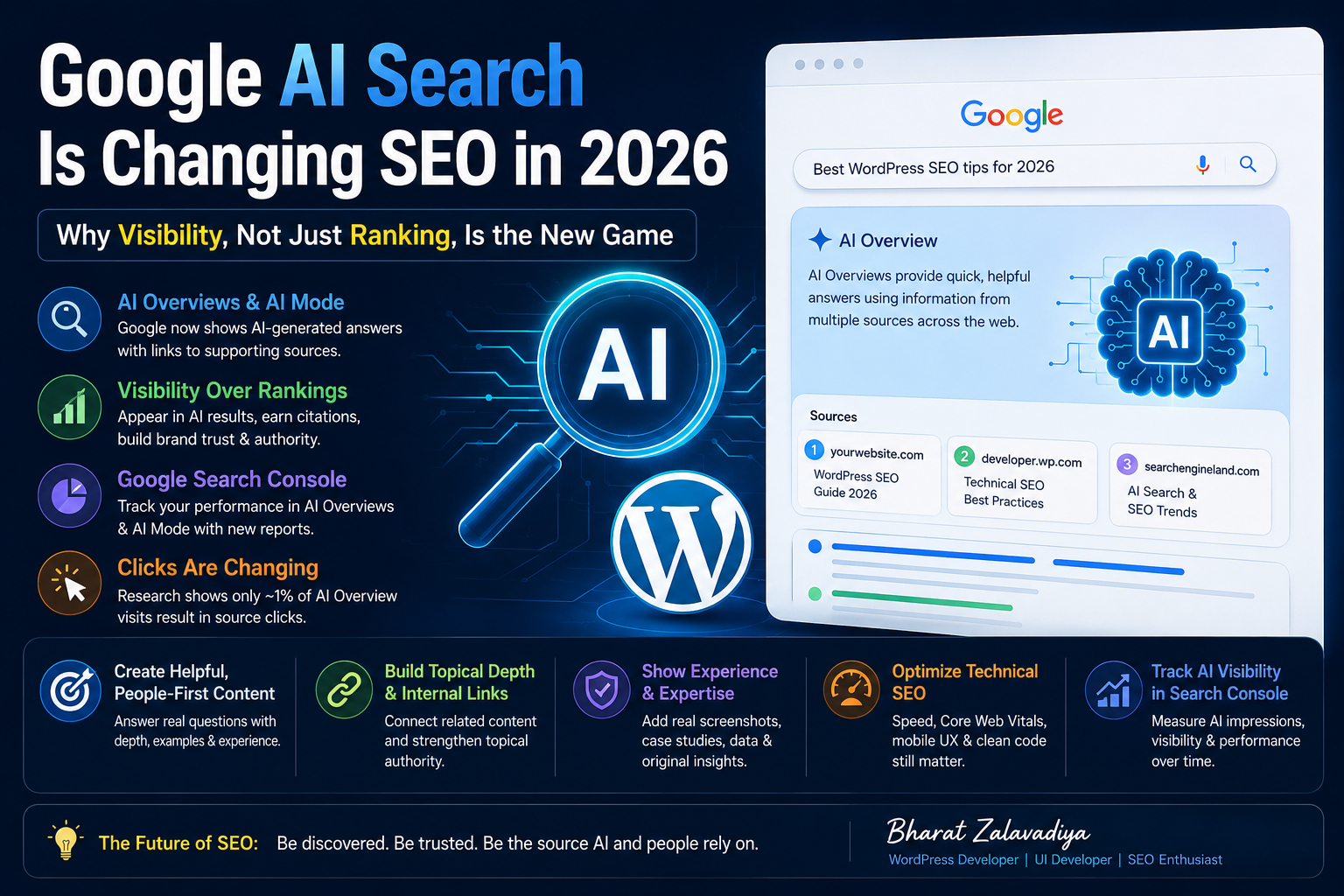
Google AI Search Is Changing SEO in 2026: Why Visibility Matters More Than Rankings
By: Bharat Zalavadiya | Focus Keyword: Google AI Search SEO
Introduction: SEO Is Changing Faster Than Ever
For years, SEO had a relatively simple objective: get your website to rank as high as possible in Google's organic search results. The traditional formula looked like Keyword → Content → Ranking → Click → Traffic.
Google Search in 2026 looks different. AI Overviews and AI Mode are changing how people discover information. Instead of simply displaying a list of links, Google can synthesize information from multiple sources and provide an AI-generated response with links to supporting websites.
That creates a new SEO challenge: your website does not only need to rank. It needs to be visible, understandable, useful and trustworthy enough to be surfaced as a supporting source.
Google's documentation says AI Overviews and AI Mode rely on the same foundational SEO principles used across Google Search. There is no secret AI schema that guarantees inclusion. Pages still need to be accessible to Google, eligible for Search, and useful to people.
What Is Google AI Search?
Google AI Search refers to Google's AI-powered search experiences, particularly AI Overviews and AI Mode. These experiences help users explore complex questions by synthesizing information and surfacing links to relevant sources.
For website owners, this means one page can potentially be discovered through several related search paths instead of one exact keyword. A detailed WooCommerce performance guide, for example, may be relevant to questions about checkout speed, plugins, database queries, caching, payment gateways and Core Web Vitals.
This makes topical depth increasingly important. Instead of writing one shallow page for every keyword variation, create genuinely useful resources that answer the main problem and its important supporting questions.
AI Overviews vs Traditional Google Search
Traditional Google Search primarily presents ranked results and asks users to choose a page. AI Overviews add another layer by giving users a synthesized explanation and links to supporting sources.
The user journey can therefore become Search → AI-generated answer → Source visibility → Possible click → Engagement.
A click is still valuable, but visibility itself can also matter. A user may see your brand as a source, remember it, and later search for the brand directly.
The New SEO Concept: Visibility
Ranking is a position. Visibility is broader. It can include traditional rankings, AI Overview appearances, AI Mode appearances, source citations, impressions, branded searches, clicks and conversions.
A page could rank number three for a keyword but not be included in an AI-generated answer. Another page could rank lower traditionally but be surfaced as a supporting source. This is why modern SEO reporting should not depend on one ranking number.
Google Search Console Is Evolving
Google has introduced a Generative AI performance report in Search Console for eligible properties. The report provides visibility data for generative AI features such as AI Overviews and AI Mode.
This gives website owners a way to begin measuring AI-search exposure rather than relying only on assumptions. Depending on availability, the report can help analyze pages, countries, devices and dates associated with generative AI impressions.
What Does an AI Impression Mean?
Google's Search Console documentation describes impressions in the Generative AI performance report as times when links to a site were shown to users within a generative AI feature on Google Search.
An AI impression does not necessarily mean that a user clicked. It means your website had visibility inside an AI-powered search experience. That distinction is important when comparing AI-search data with traditional CTR.
A useful reporting model is AI visibility → source exposure → click → engagement → conversion.
The 1% Citation Click Finding
Recent research published in August 2026 analyzed Google search behavior and reported that clicks to sources cited inside AI Overviews occurred in about 1% of AI Overview visits in its study sample.
This should not be interpreted as meaning citations are useless. It demonstrates that citation visibility and direct traffic are different KPIs. A source can gain exposure even when a user does not immediately open the cited page.
For publishers, the practical question is broader: how much value comes from being recognized as a source before a direct website visit happens?
Why Ranking Alone Is No Longer Enough
Imagine two WordPress tutorials. Website A ranks #1 but has limited original evidence and is not surfaced in AI results. Website B ranks #5, includes original screenshots, real implementation details and a strong author profile, and is surfaced as a supporting source.
Website A has the stronger traditional position. Website B may have stronger AI-search visibility. The lesson is not to ignore rankings; it is to build content that performs well across multiple search experiences.
What Makes Content More Useful for AI Search?
1. Answer the Question Clearly
Do not hide the answer under a long introduction. Give the user a clear answer early, then explain the reasoning, implementation steps and edge cases.
2. Build Topical Depth
Cover the important subtopics surrounding the main problem. For WordPress performance, that could include caching, images, JavaScript, databases, CDN configuration, plugins and Core Web Vitals.
3. Add Original Experience
Original screenshots, benchmarks, testing notes, implementation details and case studies make content more distinctive than generic AI-generated articles.
4. Use Practical Examples
Examples give readers context. Explain the problem, why it happens, what to test, what to change and what risks to consider.
5. Use Clear Structure
Use a descriptive H1, logical H2 and H3 headings, concise paragraphs, lists, examples and FAQs. Structure should help people navigate rather than simply insert keywords.
6. Strengthen Author Expertise
Technical content benefits from clear authorship. Show who wrote the article and why that person is qualified to discuss the topic.
7. Keep Content Updated
Technology changes quickly. Update articles with meaningful improvements such as new benchmarks, screenshots, WordPress changes, plugin changes and new search developments.
How WordPress Developers Should Adapt Their SEO Strategy
WordPress developers can build strong content ecosystems by creating topic clusters rather than isolated keyword pages.
For a main topic such as WordPress Performance Optimization, supporting resources might cover Core Web Vitals, WooCommerce speed, database optimization, image optimization, caching, CDN configuration, JavaScript optimization, hosting and plugin audits.
Connect these resources with contextual internal links. This helps users discover related information and helps search engines understand relationships between pages.
GEO Does Not Mean Replacing SEO
Generative Engine Optimization, or GEO, is commonly used to describe efforts to improve visibility in AI-generated answers. But GEO should not mean abandoning traditional SEO.
A stronger approach is SEO fundamentals + useful content + original information + clear structure + trustworthy references. Google states that AI Overviews and AI Mode do not require special AI-only technical optimization.
What About Schema Markup?
Structured data can help search engines understand content when implemented correctly, but there is no special schema that guarantees AI Overview or AI Mode inclusion.
Use appropriate structured data such as Article, BlogPosting, BreadcrumbList, Organization or Person when it accurately describes visible page content. Never add misleading or invisible structured data just to target AI search.
Internal Linking Becomes Even More Important
Internal links help readers move between related resources and help search engines understand your site's topical relationships.
For example, an article about Google AI Search for WordPress developers can naturally link to guides about WordPress technical SEO, Core Web Vitals, AI prompts, WooCommerce optimization and WordPress security.
Measure More Than Organic Traffic
A modern SEO dashboard should combine traditional and AI-search metrics.
- Traditional: impressions, clicks, CTR and average position.
- AI Search: generative AI impressions and AI-visible pages where reporting is available.
- Business: leads, sign-ups, purchases and conversion rate.
Search Console's generative AI reporting is useful because it provides a direct measurement layer for AI-feature exposure on eligible properties.
A Practical Google AI Search Strategy for WordPress
Step 1: Build Technically Healthy Pages
Keep important pages crawlable and indexable, use working internal links and canonical URLs, maintain a strong mobile experience, and make important information available as text.
Step 2: Research Questions, Not Only Keywords
Find what users want to know before, during and after a technical task or purchase.
Step 3: Create Comprehensive Pages
Answer the main question properly and cover the most useful supporting questions.
Step 4: Add First-Hand Evidence
Use screenshots, tests, benchmarks, code examples and case studies.
Step 5: Connect Your Content
Use contextual internal links to create topic clusters.
Step 6: Establish Authorship
Make the author and relevant experience clear.
Step 7: Monitor Search Console
Use traditional Search Console metrics and generative AI reporting where available.
Step 8: Improve Continuously
Update pages based on new data, user behavior, technology changes and search developments.
The Future of SEO Is Not "Rank or Die"
The old mindset was: Rank #1 or lose. The emerging mindset is: Be discoverable wherever the user is searching.
That can include traditional Google results, AI Overviews, AI Mode, Discover, YouTube, Reddit, LinkedIn, communities, brand searches and AI assistants.
Search is becoming more fragmented, so brand authority and content visibility are becoming increasingly connected to SEO.
Final Thoughts
Google AI Search is changing how people interact with information. The lesson is not to chase every new acronym or invent a secret AI optimization trick.
The fundamentals still matter: technically accessible pages, useful people-first content, original experience, clear structure, strong internal linking, accurate structured data and trustworthy authorship.
What is changing is how we measure success. A page can rank well but receive fewer clicks. A page can appear inside an AI-generated response without producing an immediate visit. A brand can gain visibility before a user ever visits its website.
That is why SEO in 2026 is increasingly about visibility, authority, citations, trust and business outcomes—not rankings alone.
For WordPress developers, the opportunity is clear: create genuinely useful content, document real experience, publish original examples, build strong topic clusters, keep technical SEO clean, use internal links intelligently and measure AI visibility when the data is available.
Frequently Asked Questions
What is Google AI Search?
Google AI Search refers to AI-powered search experiences such as AI Overviews and AI Mode that synthesize information and surface supporting web resources.
Does Google AI Search replace traditional SEO?
No. Google says existing SEO fundamentals remain relevant for AI Overviews and AI Mode.
What is an AI Overview?
An AI Overview is a Google Search experience that provides an AI-generated summary for certain queries and links to supporting web resources.
What is Google AI Mode?
AI Mode is a more interactive AI-powered search experience designed for complex questions, exploration and follow-up queries.
Can WordPress websites appear in AI Overviews?
Yes. Pages that are indexed and eligible for normal Google Search can be eligible for supporting links in AI Overviews and AI Mode, although inclusion is not guaranteed.
Does WordPress need special AI schema?
No. Google says there is no special schema.org markup required specifically for AI Overviews or AI Mode.
Does Search Console measure AI visibility?
Google has introduced a Generative AI performance report for eligible properties that includes impressions from AI Overviews and AI Mode.
Are AI Overview citations important if users rarely click them?
They can still provide source and brand exposure. Citation visibility and direct traffic should be measured separately.
What should WordPress developers do for AI SEO?
Focus on technical SEO, people-first content, original experience, clear structure, internal linking, accurate structured data and trustworthy authorship.
Is GEO the same as SEO?
No. GEO generally focuses on visibility in generative answers, while SEO covers search visibility more broadly. Strong SEO fundamentals remain the foundation.
Sources & References
- Google Search Central — AI Features and Your Website
- Google Search Console — Generative AI Performance Report
- Google Search Central Blog — Generative AI Performance Reports
- Investigating Click Behaviors on Google Search Results Pages That Produce an AI Overview